Blog/
Building Trust in Every Cut: What the 2026 Kenya Meat Expo Taught Us About Traceability
By Vet Mkononi Team
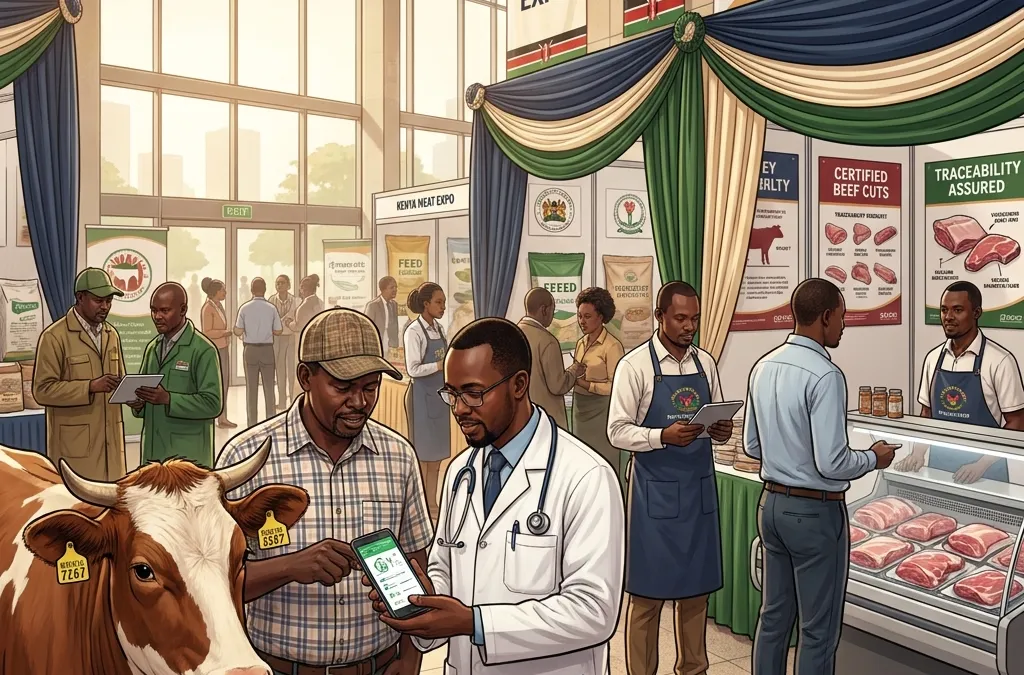
This week, the Kenyatta International Convention Centre (KICC) has been buzzing with a different kind of energy. The 5th Edition of the Kenya Meat Expo, running from 26th to 28th August 2026, has brought together farmers, processors, regulators, and innovators from across the meat value chain, all under one roof, all asking the same question: how do we build a meat industry Kenyans can trust?
For a sector that plays such an outsized role in the country’s economy and diets, it has historically been surprisingly informal. Walking through the stands this week, that reality is changing fast. Established beef brands shared floor space with feed companies, regulatory bodies, and a growing wave of agri-tech startups, all pointing to the same theme: organization, standards, and traceability.
One of the loudest conversations at this year’s expo has been around digital identification for livestock. The push for every animal, whether raised by a smallholder pastoralist or a commercial ranch, to be tagged and tracked from birth to slaughter, is no longer a theoretical policy idea. It is fast becoming the standard the industry is organizing itself around, with regulators, sector leaders, and private players all pulling in the same direction.
This matters because, as things stand, the gap between health-verified livestock and untraceable animals is stark. Livestock without proper health and vaccination records often has nowhere to go but the informal local market, sold with no way for the eventual buyer to verify where it came from, how it was raised, or whether it is safe. Meanwhile, international markets, and increasingly even discerning local ones, expect exactly the opposite: full visibility into an animal’s journey from farm to fork.
Perhaps the most honest conversations at the expo were about the local farmer, the one without a brand name on a banner, without an export contract, and often without leverage. As consumers, we rarely demand much of our meat suppliers. We don’t ask where the beef came from, whether the animal was vaccinated, or who inspected it before slaughter. That silence creates room for unscrupulous middlemen to move red meat of unknown origin into the market, undercutting the farmers who are actually doing things right.
International standards can feel completely out of reach for a farmer who has no way to prove their good practice, and who is instead at the mercy of local butchers and aggregators who set the price and ask no questions. Bridging that gap isn’t just a regulatory problem; it’s a data problem. Farmers need a simple way to record what they do, and vets need a simple way to confirm it, in a format that travels with the animal all the way to the buyer.
This is exactly the gap Vet Mkononi has been closing, and it was a central part of the conversation at our stand this week. By giving vets and farmers a shared, digital way to capture farm visits, treatments, and health records, Vet Mkononi replaces the notebook-and-memory system that has defined animal health record-keeping in Kenya for generations.
When a vet’s visit, a farmer’s practices, and an animal’s health history all live in one harmonized digital record, traceability stops being an aspiration and becomes a byproduct of everyday work. It means a beef farmer who has been doing things right finally has proof of it, proof that can follow their livestock through aggregators, processors, and all the way to the consumer’s plate.
The presence of regulatory bodies, brand-name processors, feed companies, and record-keeping innovators side by side at KICC this week is itself a signal. Kenya’s meat industry is organizing, and traceability is emerging as the thread that ties every part of that organization together, from what an animal is fed, to how it is treated, to how it finally reaches the market.
At Vet Mkononi, we believe that thread starts with good records. Harmonizing what vets and farmers already know, and making it visible where it matters, is how the local beef farmer stops being at the mercy of the market and starts being part of a verifiable, respected value chain.
Get in touch with Vet Mkononi to learn how digital record-keeping can bring traceability to your farm or practice.
Ready to try Vet Mkononi?
Digitize your practice today
Download the Android app or register on the web to start tracking visits and payments.
Vet Mkononi Team · 28 August 2026